.webp)
Vayigash: I Am Still Yosef—Come Close
Trauma, Truth, and the Inner Structure of Resilience
Dedicated in memory of our holy soldiers who fell sanctifying God’s Name and the Land of Israel:
Ephraim, son of Liat and Shmuel, Yosef Malachi, son of Dina and David, Eliyahu Moshe Shlomo, son of Sarah and Shimon, Yosef Chaim,
son of Rachel and Eliyahu, Netanel, son of Revital and Elad, Yakir, son of Chaya and Yehoshua.
May their memories be a blessing, and may the elevation of their souls bring merit and strength to the entire people of Israel.
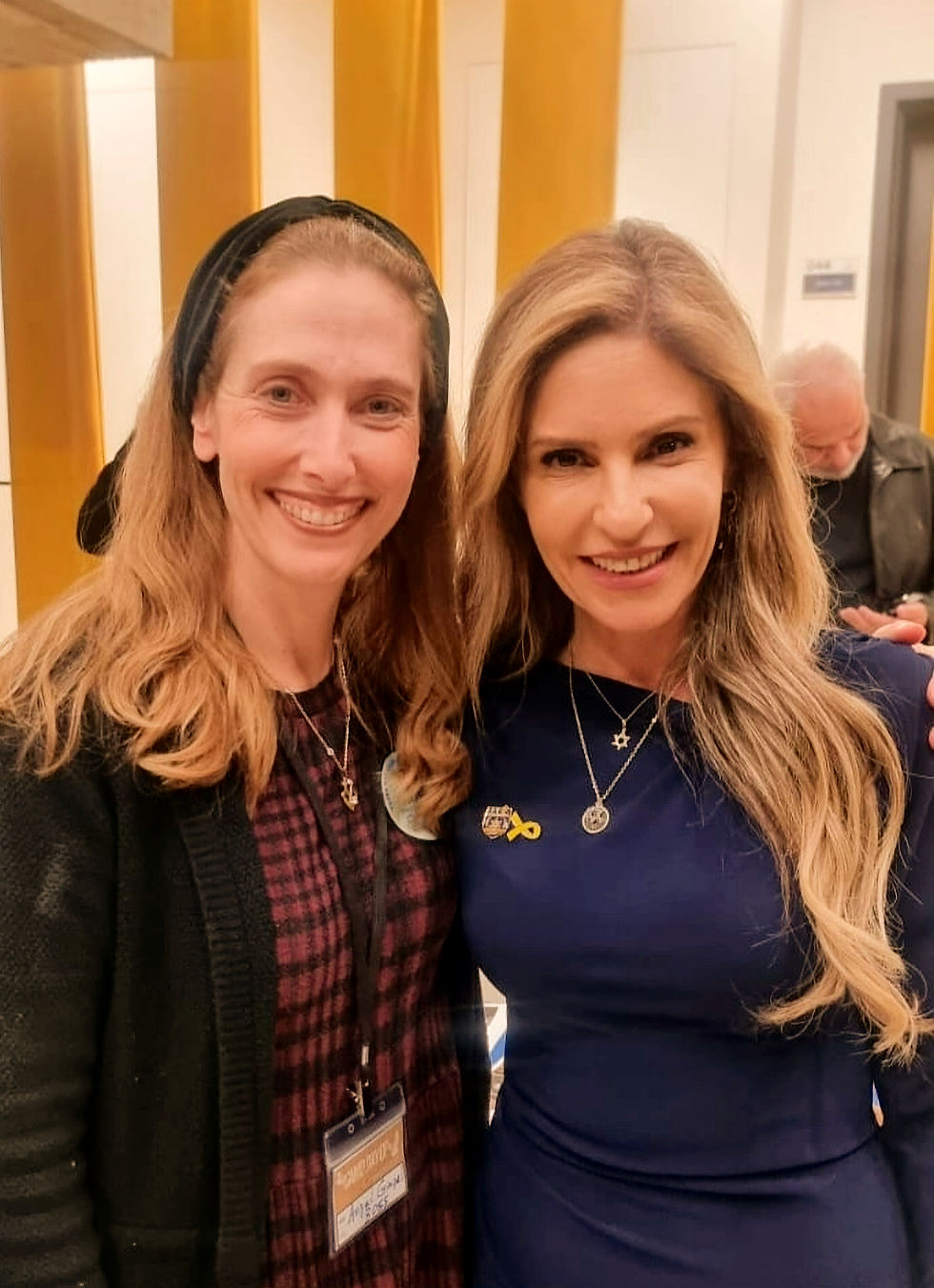
After two years of continuous war and tragedy, my husband, Daniel, and I found ourselves in the waning hours of Chanukah at a special #JAMDDayOfHope event at Hebrew University. The event brought together people who had participated in the nation's response in various ways, each carrying their own story of this challenging time. #ZAKA, #UNWatch, #Hatzala, heros who faught for that entire dark day and singlenandedly saved hundreds of our people in the South, parents of fallen hosteges, and many more gathered to remeber and celebrate hope. I wasn’t sure how I would feel being there. So many of us are moving through life with a quiet heaviness — functioning, doing, even laughing at times, yet carrying a layer of fatigue just beneath the surface.
At the event, I met a friend, Vered , whom I had only seen once before in my life. And yet when we saw each other, it felt like a reunion between sisters. That’s what trauma can do — it forges a bond when two people recognize that they have stood in the same unbearable place.
We became “sisters” the first time we met because both of us had cared for the very same fallen victims from October 7th. She stood in the room when families came to do the unimaginable: to identify the bodies of their loved ones. I stood in the room later, preparing those same bodies for burial. Two stations along the same road of horror.
This week, at the evening of Hope, we found ourselves again in the same conversation we had a year ago: how are we holding all of this? Where is the trauma sitting now? Both of us described the same inner experience: a kind of nefilat metach — a collapse of inner pressure, not drama, not hysteria, but an exhaustion of the soul. Not quite depression, but that sense of being drained and wondering: where am I supposed to find the internal energy to actually process, to heal, to keep going?
And that question opened up another one for me, much bigger than the two of us:
How do we, as a nation, keep doing this? How do we go through war after war, tragedy after tragedy, and still somehow continue? Is there something in our #spiritualDNA that gives us a kind of built-in protective capacity — a way to go through trauma and not simply be shattered by it, maybe even grow from it?
If I look into the Torah for a human being who went through the kind of psychological grinder that should destroy a person, the obvious candidate is #Yosef.
Yosef’s life should not have produced a whole, functional adult. Betrayed by his brothers. Thrown into a pit. Sold as a slave. Torn from his home as a teenager. Dragged into a foreign land. Sexual harassment and pressure day after day. False accusation. Prison. Years of invisibility. Total power imbalance. No therapist. No safe home. No secure attachment figures. No one checking if he’s okay.
By any natural measure, Yosef should have come out broken, bitter, paranoid, numb, or vengeful.
And yet, when he finally stands in front of the very brothers who destroyed his youth and declares “אֲנִי יוֹסֵף,” what do we see? Not a shattered man. Not revenge. Not humiliation. We see a person who speaks with respect, with faith, with containment, with forgiveness. Someone who can say, “It was not you who sent me here, but God,” without erasing the pain but also without drowning in it.
How is that possible? Was he born with some mythical, unattainable personality? Or is the Torah showing us a structure — inner traits that can be developed — that allows a person to pass through trauma differently?
With that question in mind, the Kli Yakar on the pasuk “גְּשׁוּ־נָא אֵלַי” (Bereishit 45:4) comes into focus in a new way. What at first seems like a brief textual moment begins to reveal a deeper structure — almost a map of Yosef’s inner world.
The Kli Yakar notes that when Yosef reveals himself to his brothers, he doesn’t just say, “I am Yosef.” He calls them closer and, in a series of short phrases, quietly signals four inner qualities that he has preserved in Egypt. The Kli Yakar connects these four to a Midrash that says Am Yisrael were redeemed from Egypt in the merit of four things: they did not change their names, did not change their language, guarded themselves in arayot, and did not become ba’alei lashon hara. Yosef, says the Kli Yakar, is shalem, complete, in all four. He is the prototype.
If we read those four as deep inner qualities of the soul, we suddenly see a Torah-based model of resilience:
A stable identity — “אֲנִי יוֹסֵף.”
An inner language that stays holy and meaningful — “כִּי פִי הַמְדַבֵּר אֲלֵיכֶם.”
Boundaries rooted in truth and covenant — “גְּשׁוּ־נָא אֵלַי,” showing the brit.
Guarded speech — refusing lashon hara, refusing to live as the victim.
There is an even deeper layer beneath all four. Yosef does not preserve his identity, language, boundaries, and guarded speech through personal strength alone. Again and again, he attributes his story to God: “It was not you who sent me here, but God.” This reflects a posture of bitul — not the erasure of the self, but the steady anchoring of the self in something greater than it.
When a person is truly connected to God, fewer forces are able to sway them. External chaos has less power to distort identity, to corrupt inner language, or to blur moral boundaries. Yosef remains aligned even when he is completely alone.
Let’s walk through each one and see how this works.
Identity: Holding the Core Self

First, identity: “אֲנִי יוֹסֵף.”A name is not a label. It’s a story. It’s continuity. It’s belonging. Pharaoh gave Yosef an Egyptian name, Tzafnat Paneach. The culture around him tried to redefine him completely. But when the brothers stand before him, Yosef does not introduce himself as the Egyptian viceroy. He says, “I am Yosef.” I am the same person whose dreams you mocked, whose coat you tore, whose life you sold. I never stopped being him, even while living a life so outwardly different that you no longer recognized the person standing before you.
Trauma often erases identity. People who go through severe pain will say, “I don’t know who I am anymore.” Yosef holds onto a core identity that Egypt can’t touch. That doesn’t mean he isn’t hurt. It means that beneath the hurt, there is a solid “I” that remains.
Inner Language: The Words That Shape Our Reality
Second, inner language:
“כִּי פִי הַמְדַבֵּר אֲלֵיכֶם.”The Kli Yakar reads this as Yosef saying: it is my own mouth speaking to you in lashon hakodesh. Outwardly, Yosef speaks Egyptian; inwardly, his mental and spiritual language is still the language of his father’s home.
Language is how we think. Language is how we interpret what happens to us. A person can go through trauma and then live the rest of their life in an internal language of “I am unsafe, worthless, abandoned, ruined.” The words they use inside their own head become their prison.
Yosef does something else. He keeps a language of emunah and meaning. He insists on seeing God’s hand in his story. He interprets dreams by looking for purpose, not doom. He doesn’t deny what people did to him, but he doesn’t let their actions become the only language he uses. His inner language stays connected to something larger and holier than his pain.
Boundaries and the Brit: Living in Alignment With Truth

Third, boundaries and the brit: “גְּשׁוּ־נָא אֵלַי.”The Kli Yakar says Yosef brings the brothers close and shows them that he is circumcised. Not as a dramatic display, but as a clear statement of identity and covenant: I remained part of the brit. I remained morally guarded in matters of sexual boundaries in a culture that was flooded with sexual permissiveness. Day after day of temptation, in a foreign house, with no one watching, with no social consequences if he gave in — and he refused.
We usually talk about this as “self-control,” but I think we can go deeper. Boundaries are not just about control. Boundaries are about truth.
A person with healthy boundaries is someone who says: There is a truth about who I am and how I am meant to live. There is a truth about what is mine and what is not mine, about what fits my inner world and what violates it. My yes and my no are not random; they are expressions of my deepest convictions.
In Egypt, every line was blurred: between master and slave, between holiness and corruption, between body and object. Trauma blurs lines too. When a person is violated, manipulated, or repeatedly hurt, they often lose their sense of what is safe, what is allowed, what is okay to say no to. Boundaries get shattered.
Yosef’s brit is the physical mark of his uncompromising commitment to truth. The brit says: I am not an object. My body is not available to every demand. My desires do not define my destiny. There is a higher truth that I answer to.
A person who is constantly searching for the moral truth of a situation — “what is really right here?” — naturally develops boundaries. And those boundaries, in turn, protect that truth. Boundaries become a living statement: this is who I am, this is what I will not cross, even when no one is looking and everything in me is tired.
Guarded Speech: Refusing the Victim Narrative

Fourth, guarded speech: refusing the victim narrative. The Kli Yakar points out something very sharp: Yosef is careful that others do not hear the details of the brothers’ betrayal. He clears the room. He draws the brothers close. He does not want Binyamin to hear. He never told Yaakov the story either, because if he had, Yaakov would have demanded reconciliation explicitly before his death. Yosef protects the dignity of the people who hurt him most.
This is not repression. He doesn’t pretend that nothing happened. He names the crime to the only people who need to hear it: “I am Yosef, whom you sold to Egypt.” But he does not turn their sin into a show. He doesn’t build his identity around telling and retelling “what they did to me.”
Lashon hara is not just a halachic category; it is also a psychological one. When a person repeatedly tells and retells the story of how they were wronged, the words begin to shape identity. The pain stays alive because it becomes the central lens through which everything is seen. Guarding speech, in this sense, is choosing not to let suffering become the whole story. There is another, deeper layer as well: lashon hara is a way of hijacking someone else’s inner world by forcing our narrative into it. When we speak badly about another — especially about someone who hurt us — we are not only expressing pain; we are attempting to control how others see, think, and feel. We recruit their perspective to carry our version of events, often before they have space to encounter the complexity for themselves.
Yosef refuses to do this. He will not seize the minds of others by shoving his story into them. He speaks only to those who must hear it, and only what must be said. He leaves room for others to see, choose, and grow on their own. In doing so, he preserves not only their dignity, but his own inner freedom.
Yosef refuses to freeze himself as the victim and his brothers as the villains. He leaves room for responsibility without turning his trauma into his identity. He speaks with precision, restraint, and dignity, allowing a larger narrative — God’s presence, purpose, and continuity — to hold the pain without erasing it.
And this brings us back to that eighth night of Chanukah, to a room full of people quietly carrying more than they can easily name. Perhaps the question is not how we erase trauma, or even how we fully heal it. Perhaps the deeper question is: what inner structures are we leaning on as we carry it forward?
Yosef teaches us that resilience is not about being untouched. It is about remaining anchored — in identity, in language, in truth, and in the stories we choose to tell about our lives. That anchoring is what allows light to keep spreading even when darkness has been overwhelming.
Standing where we stand now — as individuals who have seen too much, and as a people carrying fresh grief layered onto very old grief — Yosef is not a distant biblical hero. He is a mirror. He reminds us that strength does not mean hardness, and faith does not mean denial. It means holding onto who we are, how we speak, what we stand for, and refusing to let pain be the final word. It means staying fully connected to Hashem and attributing everything to Him.
That, perhaps, is the quiet hope of Chanukah: not that the darkness disappears, but that the light we protect within ourselves continues to grow, night after night.


Comments