.webp)
BILAM AND ISRAEL’S FORCE FIELD
- Avigail Gimpel
- Jun 25
- 7 min read
Why Bilam Could Not Curse Israel, What He Saw in the Nation’s Holiness, and Where He Found Its Weak Spot
Parshat Balak
In loving memory of the holy soldiers who fell defending Am Yisrael
Ephraim ben Liat v’Shmuel, Yosef Malachi ben Dina v’David, Eliyahu Moshe Shlomo ben Sarah v’Shimon, Yosef Chaim ben Rachel v’Eliyahu, Netanel ben Revital v’Elad, Yakir ben Chaya v’Yehoshua, and Ron ben Sarah v’Kenny
A Unusual Kind of Evil
Bilam is one of the strangest villains in the Torah.
Pharaoh has a nation to defend, Korach wants power, and Balak is frightened—each driven by fears or ambitions we can at least begin to understand, even if they lived largely in their own minds—but Bilam stands in a category of his own, for Bnei Yisrael have never harmed or threatened him, and he has no such alibi. He owes Balak nothing. God speaks to him directly and tells him exactly where the line is. Again and again Bilam discovers that he cannot curse this nation. Again and again he keeps going.
Even after the curses fail, he does not walk away. He simply changes tactics. If he cannot destroy this nation from the outside, he will find a way to weaken it from within.
What creates that kind of obsession? What draws a person so powerfully toward violating what God has blessed?
The Donkey Sees What Bilam Cannot
The Torah places one of its most striking scenes at the center of Bilam’s story.
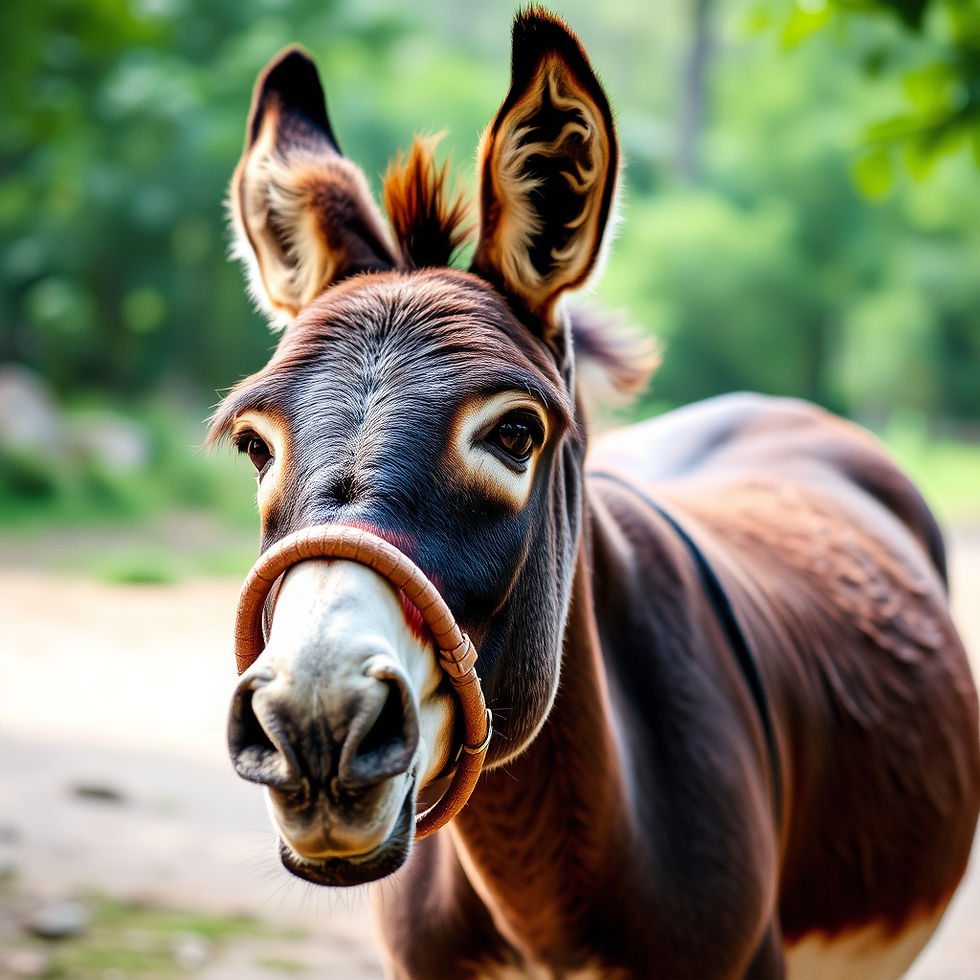
A prophet cannot see what his donkey sees.
Three times the donkey spots the angel blocking the path. Three times the road narrows. Three times the donkey stops. Three times Bilam strikes her and tries to force her forward.
The scene is humiliating, almost absurd. Yet it reveals something essential. The donkey understands that there is a point where a creature stops. The road is blocked. The path has narrowed. The right response is to yield.
Bilam cannot bear that point. Every obstacle is something to push through. Every limit is something to challenge. Every closed door is an invitation to keep trying.
Then the story becomes stranger still.
The donkey speaks.
Why Was the Donkey’s Mouth Created at Twilight?
Chazal tell us that the mouth of Bilam’s donkey was created at one of the most mysterious moments in all of creation: bein hashmashot on the first Erev Shabbat. The Mishnah in Pirkei Avot lists ten things created at that twilight hour, and one of them is פי האתון, the mouth of the donkey.

Why do we need to know that?
The Torah could simply have said that God performed a miracle in the moment. Instead, Chazal trace this event all the way back to creation itself, to the seam between weekday and Shabbat.
That detail may open a door to a deeper understanding of the parsha.
Creation advances through separation. God separates light from darkness, water from water, and sea from land. A healthy world depends on distinctions, on things occupying their proper place, on boundaries that reflect the wisdom of the One who made them. Twilight itself carries that message. It is a border. A transition. A seam between one realm and another.
Bilam collides with that reality at every turn.
God says he may not go. Bilam pushes. God permits with limits. Bilam probes those limits. One attempt fails. He moves to another mountain. The path narrows. He keeps advancing.
Bilam is fighting something larger than a single prohibition. He is fighting the structure of a God-made world. He cannot live inside a reality ordered by God’s will when that reality blocks his own.
Perhaps that is why the antidote had to be planted in creation itself.
The donkey’s mouth is prepared at the threshold between weekday and Shabbat because Bilam’s struggle is a rebellion against the architecture of creation. God built a world of holy distinctions. Bilam keeps trying to erase them. Then God suspends one of those distinctions Himself and gives speech to an animal.
That is the rebuke. The One who created boundaries can suspend them. Bilam cannot. The talking donkey is God saying: you do not control reality, you do not define its limits, and you do not own its structure.
Two Men, Two Donkeys, Two Opposite Journeys
The Torah invites us to place Bilam beside Avraham. Avraham rises early and saddles his donkey on the way to the Akeidah. Bilam rises early and saddles his donkey on the way to curse Israel. Chazal sharpen the comparison even further. In Pirkei Avot, Bilam is presented as Avraham’s opposite, the embodiment of a worldview that stands against everything Avraham built.
The comparison matters because these are two men walking into a divine command they do not control, and each responds in a completely different way.
Avraham’s journey is built on faith. He walks toward the Akeidah carrying a command he cannot possibly understand. He walks with the knowledge that Yitzchak, the future, and his entire life belong to God before they belong to him. Avraham continues walking because he trusts the One who gave the command.
Bilam rides in the opposite direction. He walks into a reality God has already defined and keeps trying to bend it. God has blessed this nation. Bilam wants access anyway. God has closed the door. Bilam keeps pressing on the handle.
Avraham’s life is built around trust that God’s world is true even when it hurts. Bilam’s life is built around the demand that reality conform to his own will.
That may be the deepest difference between them.
Avraham reaches the place where a human being says: I do not understand, but I trust.Bilam cannot say those words.
What Bilam Sees in Israel
This difference may explain the so-called blessings themselves.
We usually read Bilam’s words as admiration, as though he suddenly becomes impressed by the beauty of Israel and begins to praise it. But Bilam has given us no reason to imagine that his heart has changed. He remains focused on finding a way in.
Bilam is observing.
He has tried to penetrate Israel from the outside and failed. Now he needs to understand what has kept this nation beyond his reach. And what he sees is a nation whose strength lies in its separateness.

“הן עם לבדד ישכן” — a nation that dwells apart, a people whose identity remains distinct and intact.
“מה טובו אהליך יעקב” — homes arranged with privacy and dignity, openings that do not stare into one another’s lives, and
families who know how to preserve sacred space.
He sees a camp ordered by tribes and households, a people shaped by structure, modesty,
and restraint.
Bilam is reading the nation’s defense system. He sees that Israel’s protection lies in kedushah, and kedushah creates separateness: private spaces, sacred relationships, guarded boundaries, and forms of access that are closed. He has spent the entire parsha crashing into a force field, and now he can finally see what it is made of.
Bilam Finds the Weak Spot
And then he uses that knowledge.
Bilam learns that he cannot break Israel by cursing it from the outside. He learns that its strength lies in its holiness, in the God-given separateness that shapes its life. At that moment the next step becomes clear. If kedushah is the force field, then the way through is to weaken kedushah itself.
That is the move into Baal Peor.
Bilam sees that the nation’s power lies in covenantal distinctions, especially in the realm of intimacy and idolatry, and he attacks there. The same man who kept pushing against God’s boundaries now tries to entice Israel into pushing against its own.
That is why this section of the parsha matters so much. Bilam does not simply discover that Israel is blessed. He discovers what protects it. Once he understands that the force field around the nation is kedushah, he understands his next move as well.
The tragedy is that the same separateness that protects Israel can also become the place of attack. Once those boundaries collapse, the force field weakens from within.
The Most Dangerous Part of Bilam
Bilam’s danger lies in something more subtle than rebellion.
He remains engaged with God, speaking to Him, consulting Him, and using the language of obedience while continually returning to ask what God wants.
That is exactly what makes him so dangerous.
Bilam wants God in his life, but he wants God inside Bilam’s system. He wants divine permission, divine power, divine language, and divine access, while remaining fully committed to his own agenda. He does not surrender his will to God. He tries to recruit God into his will.
This is the slippery slope the parsha exposes. A person can remain outwardly connected to religion and still begin reshaping God in his own image. We can keep prayer, mitzvot, Torah language, and spiritual language intact while quietly moving ourselves back to the center. We can consult God while hoping the answer will confirm what we already want. We can speak in the language of submission while using faith as a tool of self-justification.
Bilam’s evil grows from exactly there. He does not abandon God. He corrupts the relationship from within. He wants prophecy without surrender, religion without humility, and God without boundaries.
When Faith Ends and Evil Begins
At that point the parsha stops being a story about curses and becomes a story about evil itself.
Evil begins when faith collapses and the self takes its place.
Evil begins when a human being stops living as a creature in God’s world and begins living as a miniature god inside it. God’s structure starts to feel suffocating. Boundaries feel insulting. Holiness feels restrictive. Another person’s blessing feels threatening. The world itself becomes something to bend.
Bilam cannot stop at the boundary and trust. He cannot release control. He cannot bear a world in which God’s will outranks his own.
And that may be why the donkey sits at the center of the story.
The donkey sees the boundary and stops. Bilam sees the boundary and keeps pushing. The donkey yields to a world she did not create. Bilam spends the entire parsha trying to bend that world to his will.
And that may be the deepest warning of Balak.
Bilam does not abandon God. He speaks to God, consults God, and keeps the language of obedience alive. Yet all the while, he is trying to draw God into Bilam’s world instead of bringing himself into God’s. He collides with Israel’s force field, studies it, identifies it as kedushah, and then looks for a way to break it from within.
That is what makes Bilam so dangerous, and that is what makes him so relevant. Evil does not always appear as rebellion from the outside. Sometimes it appears as a person who keeps God close, keeps religion intact, and quietly moves himself back to the center. Sometimes it appears as the refusal to accept that God’s boundaries are good, that His structure is wiser than our instincts, and that holiness itself depends on separateness.
Bilam saw clearly enough to identify what protects Israel. Our task is to see just as clearly. The force field around this nation is kedushah: the willingness to live as a people set apart, to guard the boundaries God gave us, and to trust that those boundaries are not walls that diminish us but the very structure that keeps us whole.


Comments