.webp)
First We Gather
Finding Our Way Back to Joy After October 7
This week's Torah is dedicated לעילוי נשמת our fallen heroes:
Ephraim ben Liat v’Shmuel • Yosef Malachi ben Dina v’David • Eliyahu Moshe Shlomo ben Sarah v’Shimon • Yosef Chaim ben Rachel v’EliyahuNetanel ben Revital v’Elad • Yakir ben Chaya v’Yehoshua • Ron ben Sara v’Kenny • Harel ben Yonat v’Shlomo
May their neshamot have an aliyah, and may their families be comforted and strengthened among all of Klal Yisrael. May the merit of their sacrifice stand for Am Yisrael, and may we know no more loss.
The Sukkah I Have Always Loved
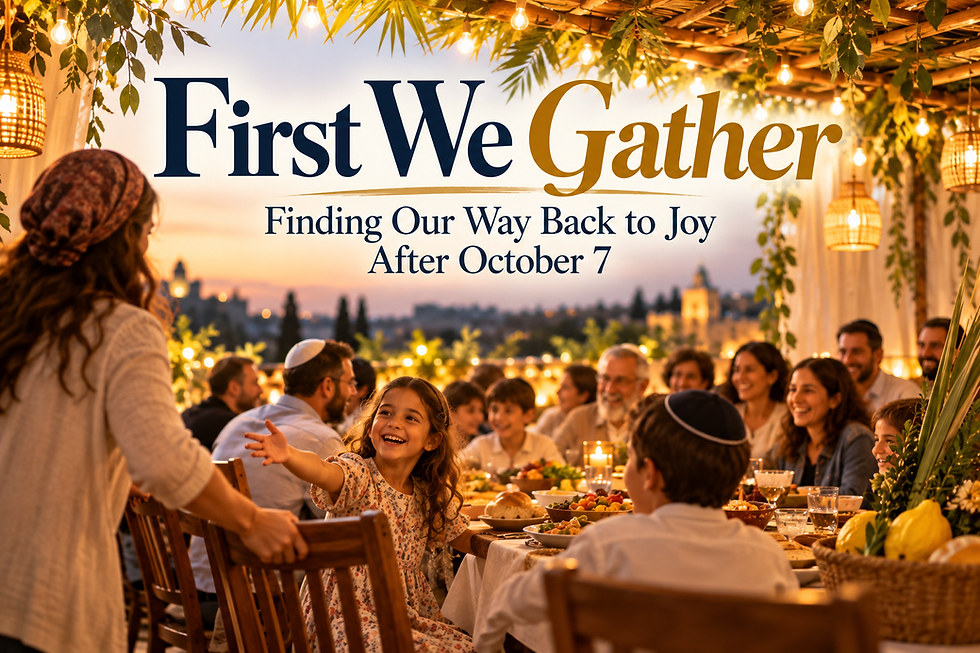
Sukkot has always been my family's favorite holiday. We don't just eat in our sukkah. We move in. We eat there, sleep there, sing there, dance there, and fill it with family, friends, neighbors, and anyone else who walks through the entryway curtains. I've always joked that all we are missing is a porta-potty and we could stay outside for the entire week.
There is another part of Sukkot that has always been a special highlight for me.
Throughout the year, I am the homemaker in the most literal sense of the word. I create the setting. I think about the food and the table and the atmosphere. I make the home feel like home.
Enter Sukkot... While I'm inside cooking way too much food, my husband and children are outside building an entirely new home for us. I hear the music, banging and voices outside, but I am barely part of it. And then, somehow, this magical structure appears.
I walk outside, and there it is: our stunning outdoor home, fully built, decorated and furnished, waiting for me.
For one week, I feel like a queen. Someone else has built the home, and I simply get to enter it.
I'm sure that's part of the reason our sukkah has always made me feel so safe. I wasn't holding everything up. I was being invited into something that had been built for me. I could sit down, look around at the people I loved, and allow myself to be held.
For years, I understood the message of the sukkah this way. We leave the sturdy walls of our homes to remind ourselves that those walls were never really what protected us. Real security comes from Hashem. We can loosen our grip, lean into Him, and allow ourselves to be cared for.
It was a beautiful thought.
Before October 7, I could say it lightly, with a beautiful, innocent faith that I long for today.
Sukkot After October 7
I can't say it lightly anymore.
This year, as my husband and one son build the sukkah while my other sons are defending our borders in Gaza and Lebanon, I hear the familiar music and banging outside and feel a knot in my stomach.
We were building sukkot then too. We were cooking, decorating, buying arba minim and preparing for Zman Simchateinu, “the time of our joy.”
We had no idea what was coming.
For years, the insecurity of the sukkah was a poetic metaphor. Now we know too much about how vulnerable life really is. When I remind myself that our walls cannot ultimately protect us, part of me responds: I know. And I don't want to know.
I want walls that protect us. I want borders that protect us. I want our soldiers and our children safe. I want Jewish families to sleep safely in their beds.
I no longer want to celebrate insecurity.
But I also don't want October 7 to take Sukkot from me, from us. I don't just want to get through it. I want to grow alongside what we have lived through.
Is there something Sukkot can teach a nation traumatized by insecurity?
Chag HaAsif
The Torah calls Sukkot חַג הָאָסִף, the Festival of Gathering.
At the end of the agricultural year, the farmer has finally finished months of work:
בְּאָסְפְּךָ אֶת מַעֲשֶׂיךָ מִן הַשָּׂדֶה — “when you gather in the results of your work from the field.”
Rashi explains the word very concretely. The produce has been lying outside in the fields, and now, before the rains arrive, אוספים אותה אל הבית — “they gather it into the house.”
That is asif. Something has been outside, exposed and scattered. Bring it in.
There, inside the meaning of the word asif, is the beginning of an answer.
The Torah begins with a very practical kind of security. Gather the harvest. Bring the year's work home. Secure the food and livelihood that will sustain your family through the coming winter.
And then comes a fascinating reversal.
The harvest is safely inside, and Hashem tells us to go outside.
We leave the house and enter a temporary structure.
But we don't go alone.
Turning What We Gathered Into a Gathering
When the Torah describes the simcha of Sukkot, it tells us who should be there:
וְשָׂמַחְתָּ בְּחַגֶּךָ אַתָּה וּבִנְךָ וּבִתֶּךָ... וְהַלֵּוִי וְהַגֵּר וְהַיָּתוֹם וְהָאַלְמָנָה — “You shall rejoice on your festival—you, your son, your daughter…the Levi, the stranger, the orphan and the widow.”
The harvest was gathered into the home.
Now the people are gathered.
We take what we have gathered and turn it into a gathering.
The grain in the storeroom provides security, but Torah directs that abundance outward.
Bring your children, your household, the person without family, the person who owns no field and harvested no grain.
Bring everyone in and rejoice together.
This brought me back to my own sukkah.
Maybe I had misunderstood what made it feel so safe all those years.
Maybe what I was feeling was connection.
My husband was there. My children were there. Friends were walking through the door. Someone always needed another chair. There was food everywhere, a sing-off with the neighbors who had also invited the entire community into their sukkah, talking, laughing, sleeping, people coming and going.
My people were gathered around me.
Of course that felt safe.
But perhaps safety wasn't the destination. It was the feeling created by belonging.
What Are We Keeping Safe?
Our generation talks constantly about safety: safe spaces, safe conversations, safe relationships, safe people. And safety matters. After October 7, none of us needs convincing of that.
But what are we working so hard to keep safe?
Our families. Our relationships. Our communities. Our lives with one another.
Everything we work to protect ultimately leads back to connection.
Connection comes with vulnerability.
To love our children is to have something unimaginably precious that we cannot completely control. To belong to Am Yisrael is to discover how deeply people we have never met can live inside our hearts.
We have learned both sides of that truth.
Sukkot brings us back to the gathering.
And Then We Take
Right in the middle of this Festival of Gathering, the Torah gives us another physical command:
וּלְקַחְתֶּם לָכֶם — “And you shall take for yourselves.”
Take an etrog, a lulav, hadassim, and aravot. Put them in your hands. Bring these different living things together and hold them.
The Sefer HaChinuch connects this mitzvah directly to the joy of the harvest. The grain and fruit have been gathered into our homes, creating a natural time of joy, and the Torah gives us these species to take in our hands and direct that joy toward Hashem.
Look at the movement the Torah creates:
בְּאָסְפְּכֶם — Gather.
וּלְקַחְתֶּם — Take.
וּשְׂמַחְתֶּם — Rejoice.
That order has been sitting with me because this year I have been surprised by how hard it is for me to feel the approach of Zman Simchateinu. I keep thinking with deep dismay: Where is my simcha?
Maybe I have been asking for the end before walking through the beginning.
First comes the gathering.
First We Gather
We are not the same people we were before that Simchat Torah. We know more about vulnerability and loss. But we have also learned how deeply connected we are.
We watched Israelis open their homes to strangers. We cooked for people we had never met. We showed up for families we didn't know. We stood at funerals of people whose names we had learned only days before. We prayed for soldiers who somehow became all of our children.
We learned how much of Am Yisrael one heart can hold.
So maybe our task is not to recover the Sukkot we had before October 7. Now we are challenged and invited to grow into this one.
We can enter the sukkah carrying everything we have learned and do what Jews have always done.
Gather.
Maybe we don't have to force the joy. Simcha may not be the starting point this Sukkot.
First we gather. We come close. We take hold.
And somewhere inside that gathering, we make room for joy to find us again.
On that note, if you are anywhere near our sukkah this year, come by!
Really.
There will be way too much food, probably not enough chairs, lots of people talking at once, plenty of laughter, and, if history is any indication, some competitive singing with the neighbors. There is always room for one more Jew in our sukkah.
That is the asif I am praying for this year.
May Hashem gather all of Klal Yisrael together—into a real achdut, a unity that makes room for our differences and still knows that we belong to one another.
May this be a year of ahavat chinam, freely given love: more open doors, more open tables, more open hearts. May we gather one another close in times of joy, not only in times of pain.
And may this Chag HaAsif bring the greatest gathering of all: all of Klal Yisrael, safe and whole, gathered together in love.
Chag sameach

Beautiful words expressing such loving thoughts. Thank you for sharing.
May HaShem continue to shelter us under His wings- in the Sukkah and all year round.
Moadim L’Simcha,
Debbie Dienstag